

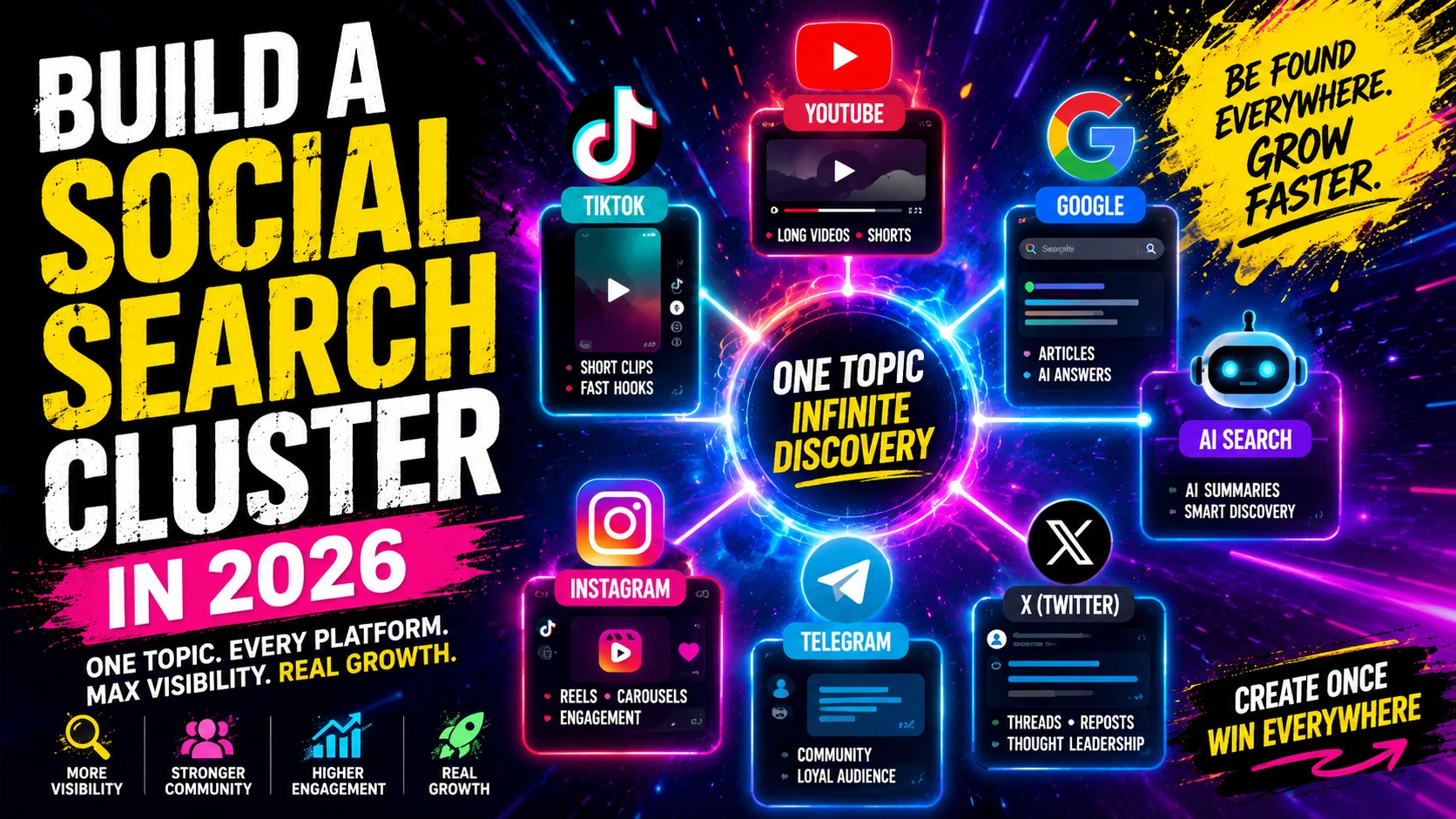
A social search cluster is a content strategy where one core topic is expanded across Google, TikTok, YouTube, Telegram, Instagram, X, and AI search results. Instead of publishing one article, one video, or one social post, creators build a connected system of long-form answers, short-form clips, community posts, comments, reposts, and engagement signals. In 2026, this approach matters because discovery is no longer limited to traditional search engines. People now find answers through feeds, social search bars, creator content, video recommendations, Telegram communities, and AI-generated summaries.
For creators, brands, streamers, educators, and online businesses, this changes the logic of promotion. A single post can still go viral, but a content cluster creates something more valuable: repeated visibility across different discovery surfaces.
The goal is not to be present everywhere at random. The goal is to turn one strong topic into a structured ecosystem of content that can be found, watched, discussed, shared, and trusted.
What Is a Social Search Cluster?
A social search cluster is a group of connected content assets built around one topic, keyword, question, product, service, or audience need.
For example, instead of publishing only one article called “How to grow a YouTube channel in 2026,” a creator can build a full cluster around that topic:
— a long-form article for Google and AI search;
— a YouTube video explaining the full strategy;
— several YouTube Shorts with quick growth tips;
— TikTok clips testing the most viral angles;
— Instagram Reels and carousels for visual discovery;
— a Telegram post with a checklist;
— X posts with key insights;
— comments and replies answering real user questions;
— updated FAQ sections based on audience reactions.
This structure gives the topic more entry points. Someone may discover it through Google. Another person may see the short version on TikTok. Someone else may join the Telegram channel after watching a YouTube Short. AI search systems may use the long-form explanation because it gives a clear definition, structure, and context.
That is the point of the cluster: one topic becomes a multi-platform discovery system.
Why Social Search Matters in 2026
In 2026, users do not search in one place.
They search on Google when they need structured information. They search on YouTube when they want tutorials, reviews, examples, and proof. They search on TikTok and Instagram when they want quick explanations, trends, opinions, and visual answers. They search inside Telegram communities when they want recommendations from people they trust. They increasingly interact with AI search interfaces that summarize information and point them toward selected sources.
YouTube’s move toward conversational AI search is a clear signal. With features like Ask YouTube, video discovery is becoming more answer-based, not only keyword-based. Users can ask complex questions and receive structured answers connected to relevant video moments.
This means creators need to think beyond classic SEO. The question is no longer only:
“How do I rank one page?”
The better question is:
“How do I make one topic visible across search engines, social platforms, video feeds, communities, and AI answers?”
That is where the social search cluster becomes useful.
The Core Structure of a Social Search Cluster
A strong social search cluster usually has five layers.
1. The Core Answer Page
The core answer page is the main long-form article or landing page. It explains the topic better than a short social post can.
This page should include:
— a clear definition of the topic;
— direct answers to common questions;
— practical examples;
— step-by-step guidance;
— comparison blocks;
— mistakes to avoid;
— updated information for the current year;
— internal links to relevant service pages;
— FAQ-style sections that AI systems can understand.
This is the page that can work for Google, AI Overviews, featured snippets, and long-term organic traffic.
For example, a page about “social search clusters” should clearly define the term, explain how the structure works, show examples, and describe how creators can build one from scratch.
2. The Short-Form Discovery Layer
The short-form layer turns the main idea into quick, platform-native content.
This layer can include:
— TikTok videos;
— YouTube Shorts;
— Instagram Reels;
— short clips from longer videos;
— quick creator tips;
— mistakes and myth-busting formats;
— before-and-after growth examples;
— short explainers based on the article.
Short-form content is not just entertainment. In 2026, it is also a search and discovery format. Users often search inside TikTok, YouTube, and Instagram before they ever visit a website.
The mistake is copying the same content everywhere. Each platform needs a different angle.
TikTok works well for fast hooks, opinions, creator mistakes, and trend-based explanations. YouTube Shorts can support tutorials, channel growth tips, and educational sequences. Instagram Reels and carousels work well for visual summaries, checklists, and personal-brand positioning.
3. The Video Authority Layer
Longer video content gives the cluster depth.
A YouTube video can explain the full system, show examples, and create stronger trust than a short post. For creators and businesses, this layer is especially important because YouTube combines search, recommendations, subscriptions, and now stronger AI-assisted discovery.
A good video authority layer can include:
— a full guide;
— a practical tutorial;
— a case study;
— a comparison video;
— a “mistakes to avoid” video;
— a Q&A video based on audience comments.
Video also gives the cluster more reusable material. One long video can become multiple Shorts, TikTok clips, Instagram Reels, quote posts, Telegram updates, and article sections.
4. The Community Layer
A cluster becomes stronger when the audience has somewhere to continue the conversation.
That place can be a Telegram channel, Telegram group, Discord server, private community, newsletter, or broadcast channel. For many niches, Telegram is especially useful because it works well for fast updates, crypto communities, private content, educational drops, and direct audience communication.
The community layer can include:
— summaries of new articles;
— checklists;
— polls;
— comments and discussions;
— updates after platform changes;
— private examples;
— answers to repeated questions;
— links back to the main article or video.
This layer helps turn attention into retention. A TikTok viewer may disappear after one video. A Telegram subscriber can become part of the long-term audience.
5. The Engagement and Proof Layer
The final layer is made of visible activity signals.
These signals include:
— views;
— likes;
— comments;
— reposts;
— saves;
— watch time;
— retention;
— Telegram post views;
— Telegram reactions;
— YouTube subscribers;
— TikTok followers;
— Instagram engagement;
— X reposts and replies.
These signals do not replace quality. But they help content look alive, tested, and relevant.
A useful content cluster should not feel empty. If the article says something important, the social layer should show that people are watching, reacting, asking, sharing, and discussing it.
Where Promotion Services Fit into a Social Search Cluster
Promotion services should not replace strategy, quality, or audience understanding. A weak topic will not become strong just because it receives views. But promotion services can help a new content cluster collect early visibility signals, test demand, and support the formats that already show potential.
For example, a creator can use YouTube views to test whether a new topic attracts initial attention. YouTube retention and watch time services can support videos that already have a strong structure but need more behavioral depth. YouTube Shorts views can help test several hooks before investing in a full campaign.
TikTok views can help identify which short-form angles get attention fastest. Instagram Reels views can support visual discovery. X reposts and views can help distribute analytical threads. Telegram members can help seed a new community around a topic. Telegram views and comments can make the channel look active when the creator starts publishing regular updates.
The clean way to use promotion services is not to fake popularity. The clean way is to support a content system that already has a clear topic, useful material, and a realistic audience.
Example: Turning One Topic into a Full Social Search Cluster
Let’s take one example topic:
“How to grow a YouTube channel in 2026.”
A weak approach would be simple:
Publish one article and wait.
A stronger approach would be to build a cluster.
Core article
The main article explains the full growth strategy:
— how YouTube discovery works;
— how to choose a niche;
— how to create videos people search for;
— how Shorts support long-form growth;
— how retention affects performance;
— how to use comments as content ideas;
— how to turn viewers into subscribers;
— how to move loyal viewers into Telegram or another community.
YouTube layer
The creator publishes one long video:
“How to Grow a YouTube Channel in 2026: Views, Retention, Shorts, and Subscribers.”
Then the creator cuts that video into Shorts:
— “3 mistakes new YouTubers make”;
— “Why views without retention do not help”;
— “How to turn Shorts viewers into subscribers”;
— “The first 7 days after publishing a new video”;
— “What to track besides views.”
TikTok layer
TikTok receives faster, sharper versions:
— “Why your YouTube channel is not growing”;
— “Stop posting random videos”;
— “One topic, five clips, one community”;
— “The social search cluster explained in 30 seconds.”
Telegram layer
The Telegram channel receives:
— a checklist;
— a weekly content plan;
— a link to the full article;
— a link to the YouTube video;
— a poll asking what creators struggle with most;
— short answers based on audience replies.
X layer
X receives a compact thread:
— definition;
— framework;
— example;
— mistakes;
— metrics;
— link to the full guide.
Promotion layer
Promotion can then support the strongest pieces:
— YouTube views for the main video;
— YouTube retention for the video that already has a strong structure;
— Shorts views for the best short clips;
— Telegram members for the community layer;
— Telegram post views for the checklist;
— X reposts for the strategic thread.
Now the topic is not only an article. It is a discoverable system.
A Practical 7-Day Social Search Cluster Launch Plan
A simple cluster can be launched in one week.
Day 1: Publish the Core Article
Start with the full article. Make it clear, structured, and useful. Add definitions, examples, FAQs, and internal links.
The article should answer the topic better than a social post can.
Day 2: Create the Main Video
Record or publish a longer YouTube video based on the article. The video does not need to repeat every word. It should explain the same idea in a more human and visual format.
Day 3: Cut Short-Form Clips
Create short clips for TikTok, YouTube Shorts, and Instagram Reels.
Each clip should cover one idea only:
— one mistake;
— one tip;
— one definition;
— one example;
— one controversial point;
— one checklist item.
Day 4: Start the Community Conversation
Publish a Telegram post with a short summary and a practical checklist. Ask one specific question to generate replies.
For example:
“What is harder for you right now: getting views, keeping retention, or turning viewers into subscribers?”
Day 5: Publish a Thread or Analytical Post
Use X or another text-first platform to publish the strategic version of the idea. This is useful for creators, marketers, founders, and people who prefer frameworks over videos.
Day 6: Collect Comments and Update the Article
Look at comments, replies, Telegram reactions, and questions.
Then update the article with new FAQ blocks. This makes the article more useful and gives search engines more direct answers to index.
Day 7: Scale the Strongest Format
At the end of the week, compare performance.
Do not scale everything equally. Scale what shows early traction.
If TikTok clips get attention, produce more short videos. If YouTube retention is strong, support the video with more distribution. If Telegram discussions are active, publish more community-first content. If the article gets impressions, improve internal linking and add more examples.
Metrics to Track in a Social Search Cluster
A social search cluster should be measured across several groups of metrics.
Discovery Metrics
These show whether people are finding the content:
— impressions;
— video views;
— profile visits;
— search appearances;
— reach;
— suggested video traffic;
— social feed exposure.
Engagement Metrics
These show whether people care:
— comments;
— replies;
— saves;
— shares;
— reposts;
— reactions;
— poll answers;
— direct messages.
Video Quality Metrics
These show whether the video format works:
— retention;
— watch time;
— average view duration;
— repeat views;
— completion rate;
— subscriber conversion.
Community Metrics
These show whether attention is becoming audience ownership:
— Telegram members;
— post views;
— comment activity;
— reaction rate;
— returning viewers;
— link clicks from the community.
Conversion Metrics
These show whether the cluster creates business value:
— service page visits;
— registrations;
— orders;
— trial signups;
— paid community joins;
— leads;
— repeat purchases.
The key is to avoid looking only at views. Views matter, but they are only one layer. A serious cluster should also create retention, discussion, subscribers, community growth, and conversions.
Common Mistakes When Building a Social Search Cluster
Mistake 1: Publishing the Same Content Everywhere
A TikTok clip, YouTube Short, Telegram post, and long-form article should not be identical. They can share the same idea, but each format needs its own structure.
Mistake 2: Promoting Before the Topic Is Clear
Promotion works better when the topic is specific. “How to grow online” is too vague. “How to turn TikTok views into Telegram members” is clearer and easier to distribute.
Mistake 3: Ignoring Comments
Comments are not just engagement. They are a content research tool.
A repeated comment can become:
— a FAQ answer;
— a new short video;
— a Telegram post;
— a section in the article;
— a future article topic.
Mistake 4: Treating Telegram as a Link Dump
Telegram works best when it gives people a reason to stay. If the channel only reposts links, it will not become a community. It should publish updates, summaries, short opinions, checklists, polls, and practical notes.
Mistake 5: Measuring Only Virality
Virality is useful, but it is unstable. A cluster should be judged by repeatable signals: search visibility, retention, comments, community growth, subscribers, and conversions.
Why Social Search Clusters Work for Creators and Brands
Social search clusters work because they match how people actually discover information in 2026.
A user may start with a TikTok clip, then search the topic on YouTube, then read a full article, then join a Telegram channel, then return later through Google or AI search. The path is not linear.
Creators and brands that understand this can build stronger visibility. They do not depend on one algorithm, one post, or one viral moment. They create a network of content around the same topic.
This is especially useful for:
— YouTube creators;
— TikTok creators;
— Telegram channel owners;
— streamers;
— crypto communities;
— online educators;
— SaaS products;
— media projects;
— personal brands;
— agencies;
— e-commerce brands;
— local businesses with strong content angles.
The more competitive discovery becomes, the more important structure becomes.
The Future of Social Search Is Connected
The future of content growth is not only SEO, not only social media, and not only paid promotion. It is the connection between them.
A strong topic should have a search page. It should have video content. It should have short clips. It should have comments. It should have community discussion. It should have proof that people are paying attention.
That is what a social search cluster creates.
In 2026, creators and brands should stop asking where to publish one post. They should ask how to turn one strong idea into a connected discovery system across Google, YouTube, TikTok, Instagram, Telegram, X, and AI search.
The creators who win will not always be the ones with the biggest audience at the start. They will be the ones who build the clearest topic clusters, test formats quickly, support the strongest signals, and turn scattered attention into a structured audience.
About the author


Leave a Reply