

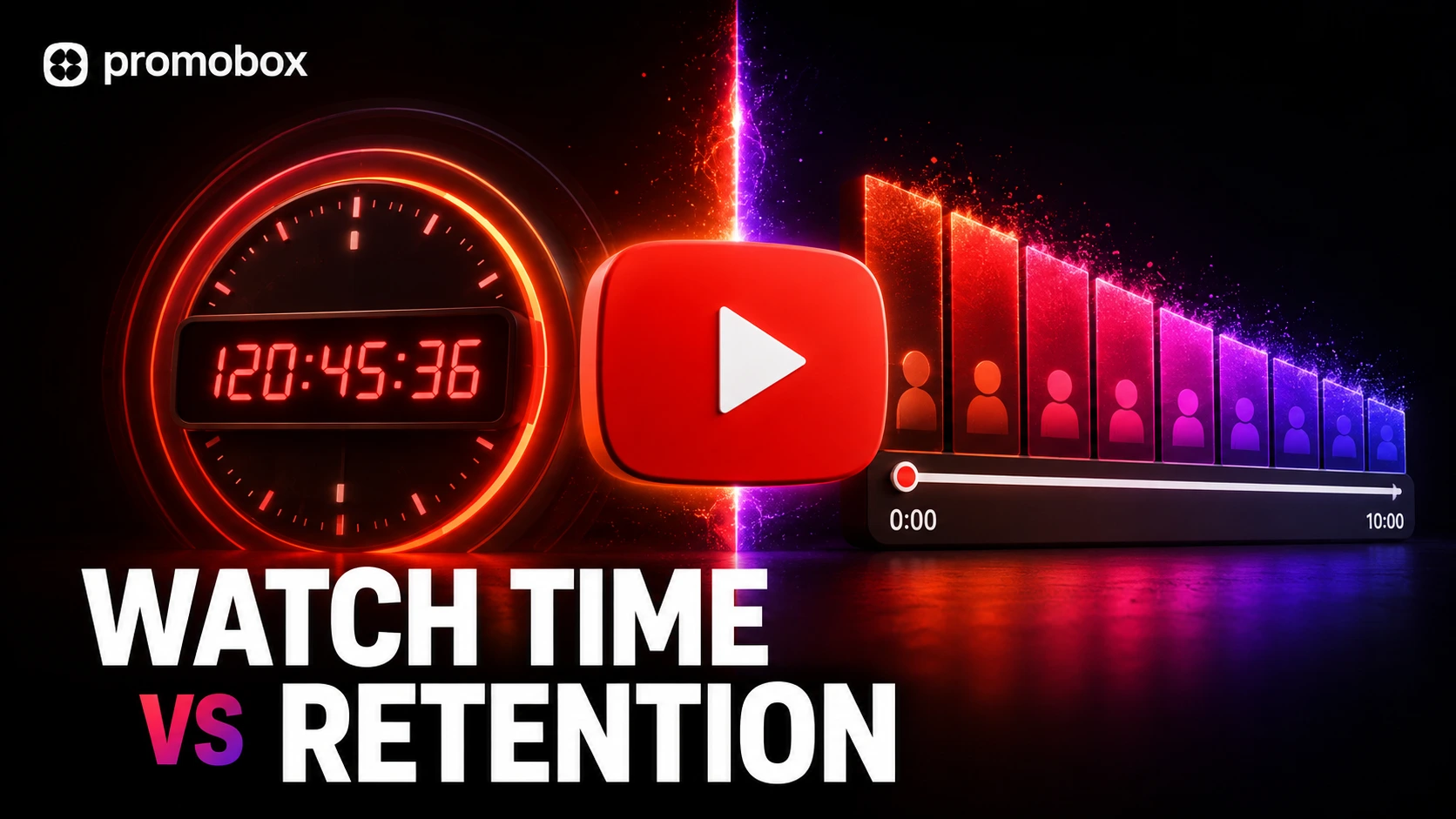
YouTube watch time measures the total amount of time viewers spend watching a video or channel. Audience retention shows how successfully a video keeps viewers watching as it progresses.
The two concepts answer different questions:
- Watch time: How many total minutes or hours did viewers watch?
- Audience retention: How much of the video did viewers continue watching, and where did they lose interest?
A video can generate substantial watch time while having modest audience retention. Another video can retain most viewers but produce little total watch time because it is short or has attracted only a small audience.
Watch Time vs Audience Retention: Quick Comparison
| Metric | What it measures | Typical unit | Main question answered |
|---|---|---|---|
| Watch time | Total time accumulated across viewers | Minutes or hours | How much viewing time did the video generate? |
| Average view duration | Average time watched per playback | Minutes or seconds | How long did the average viewer watch? |
| Average percentage viewed | Average share of the video watched | Percentage | What proportion of the video did viewers watch? |
| Audience retention | How viewership changes throughout the video | Percentage by timestamp | Where did viewers stay, leave, skip or rewatch? |
YouTube defines watch time as the amount of time viewers have watched a video. Its Analytics API describes estimatedMinutesWatched as the number of minutes users watched a channel, video or playlist.
YouTube describes its audience-retention report as a way to understand how well different moments of a video held viewers’ attention. The report can reveal a strong introduction, gradual drop-off, spikes and dips.
What Is YouTube Watch Time?
YouTube watch time is the cumulative duration of all viewing activity.
If one person watches four minutes of a video and another watches six minutes, those two views generate ten minutes of total watch time.
A simplified calculation is:
Total watch time = sum of all minutes watched
Watch time depends on several factors:
- The number of views
- How long each viewer watches
- The length of the video
- Whether viewers return or watch again
Watch time is an aggregate metric. It does not, by itself, explain whether viewers watched the beginning, skipped the middle or left before the conclusion.
According to the official YouTube Analytics metrics documentation, the platform also reports average view duration and average percentage viewed. These related measurements provide context that total watch time alone cannot supply.
What Is YouTube Audience Retention?
Audience retention describes how the remaining audience changes from one moment of a video to the next.
The retention graph begins with the viewers present near the start and follows the percentage still watching across the timeline. A declining line indicates that viewers are leaving. Individual dips may show that viewers skipped a section or stopped watching, while spikes may indicate that a moment received more views, was rewatched or was shared.
YouTube’s audience-retention documentation identifies several types of key moments:
- Intro: The percentage of viewers still watching after the first 30 seconds
- Top moments: Sections where few viewers stopped watching
- Spikes: Moments that received more views, were rewatched or were shared
- Dips: Sections that viewers skipped or where they stopped watching
The detailed audience-retention report is available at the individual video level. YouTube notes that retention data typically takes one to two days to process.
The Main Difference
The simplest distinction is that watch time measures volume, while audience retention measures continuity.
Consider this illustrative example:
- Video length: 10 minutes
- Views: 100
- Average viewing duration: 4 minutes
The approximate total watch time is:
100 views × 4 minutes = 400 minutes
The simplified average percentage viewed is:
4 minutes ÷ 10 minutes × 100 = 40%
The 400-minute figure describes total consumption. The 40% figure indicates how much of the video the average viewer watched. The retention graph would then show where viewers were lost, retained or brought back.
This is a mathematical illustration, not a prediction of how YouTube will record or evaluate a specific video.
Why Watch Time Can Increase While Retention Falls
Watch time and audience retention do not always move in the same direction.
Suppose a creator publishes a 30-minute video that viewers watch for an average of 12 minutes. The simplified average percentage viewed is 40%.
A second video is only five minutes long and viewers watch an average of four minutes. Its simplified average percentage viewed is 80%.
| Video | Length | Average view duration | Simplified average percentage viewed |
| Video A | 30 minutes | 12 minutes | 40% |
| Video B | 5 minutes | 4 minutes | 80% |
Video A has the lower percentage but generates three times as much average viewing duration per view. Video B holds viewers through a greater proportion of its runtime but adds fewer minutes per view.
Neither result is automatically better. The appropriate comparison depends on the video’s format, length, subject and purpose.
Can a Video Have High Retention but Low Watch Time?
Yes. A short video watched almost to completion may have strong retention but generate relatively little total watch time.
For example, 100 views with an average duration of 50 seconds would produce approximately 83 minutes of watch time. The video could have high percentage retention if it is only one minute long, but the small audience and short runtime limit the total viewing time accumulated.
The opposite is also possible. A long video with many views can generate substantial watch time even if most viewers do not reach the end.
How to Read the Metrics Together
Watch time tells you the size of the result. Retention helps explain how that result was produced.
| Result | Possible interpretation | What to investigate |
| High watch time and strong retention | The video attracts viewers and holds attention | Traffic sources, successful topics and repeatable format elements |
| High watch time and weak retention | Reach or video length is producing minutes despite viewer loss | Opening, pacing, title-to-content alignment and major dips |
| Low watch time and strong retention | Existing viewers respond well, but reach or runtime is limited | Distribution, topic demand, packaging and related-video opportunities |
| Low watch time and weak retention | The video is neither attracting enough viewing nor sustaining interest | Topic, thumbnail, title, introduction, structure and production |
“High” and “low” should be judged against comparable videos. A tutorial, podcast, product demonstration and short entertainment clip naturally produce different viewing patterns.
Comparing a 45-minute interview with a two-minute explainer solely by percentage viewed can produce a misleading assessment.
Which Metric Should You Improve First?
Start with the metric that identifies the clearest constraint.
Improve retention when viewers leave early
If the retention graph shows a major decline during the introduction, examine whether the opening delivers what the title and thumbnail promised.
Potential improvements include:
- State the value of the video early
- Remove repetitive introductions
- Show the result before explaining the process
- Avoid unrelated background information
- Move essential information closer to the beginning
A drop does not always indicate a problem. Viewers may leave after receiving the exact answer they needed, so the surrounding context matters.
Improve watch time when retention is healthy but total viewing remains limited
If viewers already watch a meaningful portion of the video, low total watch time may reflect limited reach, a narrow topic or a small number of views.
Possible actions include:
- Create follow-up videos for the same search intent
- Connect related videos with playlists and end screens
- Improve titles and thumbnails without misrepresenting the content
- Update older videos with relevant links
- Expand topics that already demonstrate sustained viewer interest
Extending a video solely to accumulate more minutes is not a reliable solution. Additional length only contributes useful watch time when viewers continue watching the added material.
Where to Find Watch Time and Retention in YouTube Studio
YouTube places both measurements in the Analytics area:
- Open YouTube Studio.
- Select Content and choose a video.
- Open Analytics.
- Select the Engagement tab.
- Review watch time, average view duration and key moments for audience retention.
The YouTube Engagement help page confirms that the Engagement tab includes watch time, average view duration and audience-retention information.
Channel-level watch time is useful for evaluating overall viewing volume. The video-level retention report is more suitable for diagnosing specific moments in an individual video.
Promobox YouTube Watch Time and Retention Services
Promobox lists separate services for YouTube watch time and YouTube watch retention. The services use different order units:
- Watch-time packages are priced by ordered hours.
- Retention packages are priced by views with a selected viewing duration.
These services should not be confused with YouTube Studio analytics. An order does not guarantee a particular organic retention curve, search position, recommendation outcome, monetization decision or recognition of every ordered hour by YouTube.
Promobox YouTube Retention Prices
The following rates were checked on September 4, 2026:
| Selected viewing duration | Price per view | Price per 1,000 views |
| 1 minute | $0.0015 | $1.50 |
| 2 minutes | $0.0024 | $2.40 |
| 3 minutes | $0.0030 | $3.00 |
| 5 minutes | $0.0040 | $4.00 |
| 15 minutes | $0.0090 | $9.00 |
These options represent selected viewing durations for the ordered views. Multiplying duration by quantity provides a theoretical viewing-time calculation, not a guarantee of the watch time that YouTube will record or consider eligible for a platform programme.
Promobox YouTube Watch Time Prices
The following rates were checked on September 4, 2026:
| Package | Published rate |
| Watch Time (Hours) + Views for videos of 5 minutes or longer | $20 per 1,000 ordered hours |
| YouTube Watch Time for videos of 60 minutes or longer, up to 1,000 hours per day | $30 per 1,000 ordered hours |
| Watch Time (Hours) for videos of 60 minutes or longer | $38 per 1,000 ordered hours |
Prices and available packages can change. Check the live Promobox YouTube watch-time order page before ordering.
Other promotion options are listed in the Promobox YouTube services catalogue.
Sources
About the author





Leave a Reply