

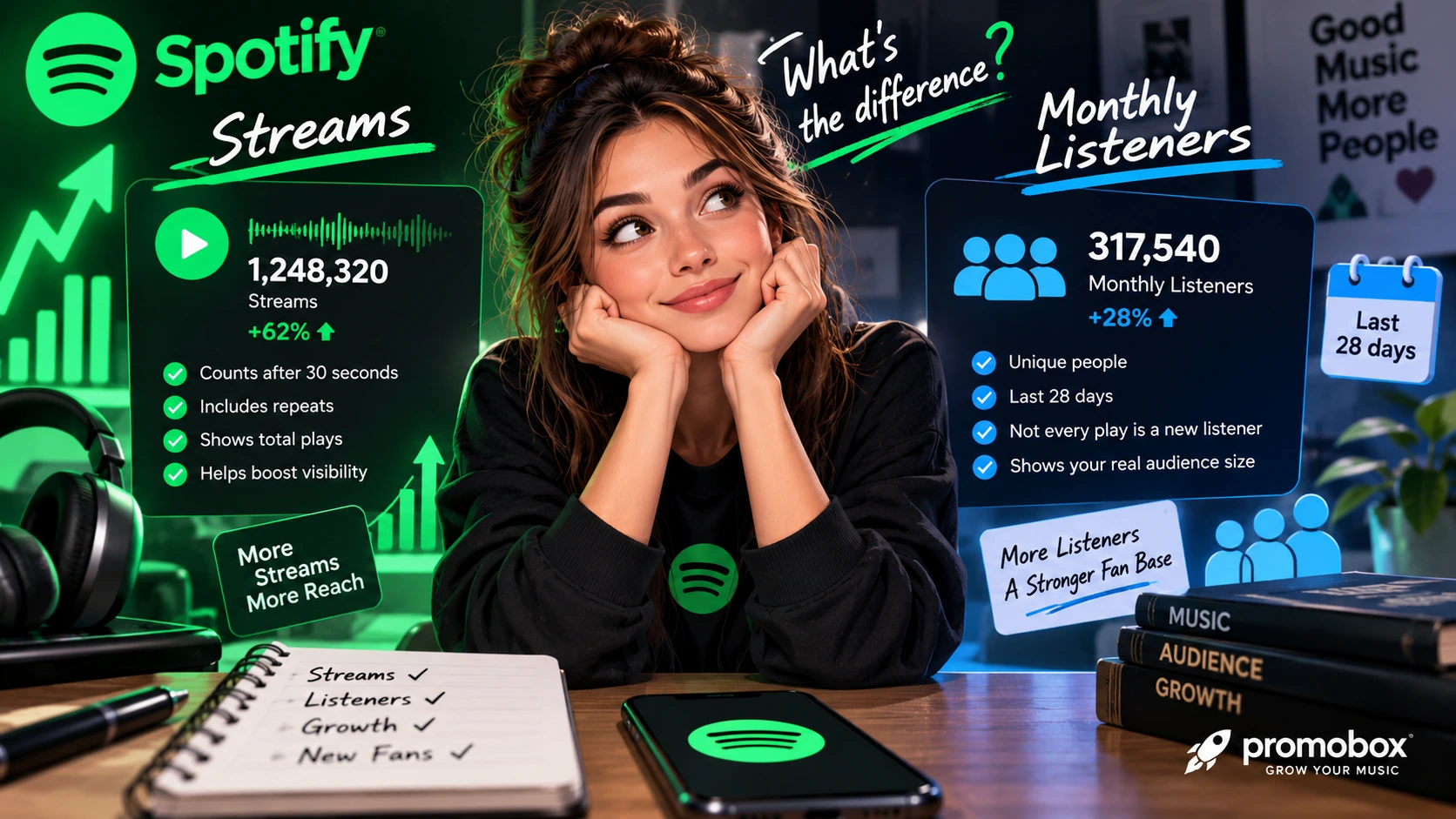
Spotify Streams vs Monthly Listeners: The Short Answer
Spotify streams and monthly listeners measure different things. A stream is counted when someone plays a song for at least 30 seconds. Listeners are unique people who streamed your music during the selected reporting period, while monthly listeners represent the unique audience reached during the latest rolling 28 days.
One person can generate several streams while still counting as one listener. Because of that, streams can increase even when monthly listeners fall.
Spotify explains these metrics in its listener and follower data documentation.
Streams, Listeners, Monthly Listeners and Followers Compared
Spotify for Artists separates playback volume from audience size.
| Metric | What it measures | Time period | What it cannot tell you alone |
|---|---|---|---|
| Streams | Qualifying plays of your music | Selected period or cumulative total | How many different people listened |
| Listeners | Unique people who streamed your music | Selected reporting period | How many repeat streams each person generated |
| Monthly listeners | Unique people who streamed your music | Rolling last 28 days | The size of your stable fan base |
| Followers | People who follow your artist profile | Current total or change over time | How many followers are currently listening |
A listener is a unique person who streamed your music during the period you selected. A follower, by contrast, is someone who chose to follow your artist profile.
Monthly listeners use a different time frame. Spotify calculates them from the latest rolling 28-day period and includes listening from both active and programmed sources. You can read more in Spotify’s Audience Segments guide.
Why You Should Not Compare Unmatched Metrics
Suppose one track has:
- 500,000 all-time streams
- while the artist currently has 80,000 monthly listeners
Those numbers should not be divided to estimate streams per listener.
The first figure may cover one track across several years. The second covers the artist’s whole catalog during only the latest 28 days.
For useful comparisons, keep both the time period and the data level consistent.
Compare:
- track with track;
- release with release;
- artist with artist;
- 7 days with 7 days;
- or 28 days with 28 days.
How Spotify Counts Streams
The 30-Second Rule
Spotify counts a song stream after the listener plays it for at least 30 seconds.
The current rule is documented in Spotify’s How your streams are counted guide.
That threshold matters because a track start is not automatically the same as a counted stream.
Can One Listener Generate Multiple Streams?
Yes.
The same person can return to a song and generate several qualifying streams while remaining one unique listener during the selected period.
Consider this simple example:
- Listener A plays a track 5 times.
- Listener B plays it 3 times.
- Listener C plays it once.
If all nine plays meet Spotify’s counting requirements, the result is:
9 streams from 3 unique listeners.
A high stream count can therefore come from:
- many people listening once;
- fewer people listening repeatedly;
- or a combination of both.
That is why streams alone do not reveal audience size.
Artificial Streams and Spotify Rules
Spotify also filters activity it considers artificial.
The platform describes artificial streaming as activity that does not represent genuine user listening intent, including attempts to manipulate stream counts through automated systems such as bots or scripts.
Spotify also warns artists about third-party services that guarantee streams. Its current policy is explained in Artificial streaming and paid third-party services that guarantee streams.
Stream counting and royalty eligibility should also be treated as separate questions. A visible change in a stream counter does not by itself explain how royalties will be handled.
Why Streams Can Rise While Monthly Listeners Fall
This is one of the most confusing situations in Spotify for Artists:
streams go up while monthly listeners go down.
There is no contradiction.
How the Rolling 28-Day Window Works
Monthly listeners are calculated using a rolling 28-day window.
As each new day enters the window, the oldest day drops out.
That means:
- new listeners can enter;
- recent listeners can remain;
- older listeners can disappear from the monthly total if they stop listening.
Streams, meanwhile, measure playback activity during the reporting period you choose.
A smaller number of people can therefore generate more streams through repeat listening.
Example: 10,000 Listeners vs 14,000 Streams
Consider two hypothetical artist-level 28-day periods.
Period A
- 10,000 unique listeners
- 12,500 streams
Period B
- 7,000 unique listeners
- 14,000 streams
The audience decreased:
10,000 → 7,000 listeners
Yet playback increased:
12,500 → 14,000 streams
Suppose an earlier playlist placement or social-media spike introduced thousands of people during Period A. Many listened once and did not return.
As those listeners move outside the 28-day window, they disappear from the monthly-listener figure.
At the same time, a smaller group continues replaying the artist’s music.
The result is fewer unique people but more total streams.
For that reason, falling monthly listeners should not automatically be interpreted as a penalty, reporting error or technical problem.
What Streams per Listener Can Tell You
Streams per listener is useful because it connects playback volume with audience size.
How to Calculate Streams per Listener
Use this formula:
Streams per listener = streams ÷ unique listeners
Spotify also includes streams-per-listener analysis within its Source of Streams reporting.
Always use:
- the same dates;
- the same data level;
- the same reporting scope.
Example: 3,000 Streams From 1,000 Listeners
Suppose a track generates:
- 3,000 streams
- 1,000 unique listeners
during the same period.
The calculation is:
3,000 ÷ 1,000 = 3
So the result is:
3 streams per listener
That does not mean every person played the track three times.
Some may have listened once. Others may have streamed it ten times.
The metric is an average.
What the Number Does Not Prove
There is no universal streams-per-listener figure that automatically means a release is successful.
A higher number may indicate more repeat playback, but it does not prove:
- fan loyalty;
- long-term retention;
- follower growth;
- future listening behavior;
- commercial intent.
Use it as one part of a broader analysis.
Monthly Listeners vs Monthly Active Listeners
Spotify also distinguishes between monthly listeners and monthly active listeners.
What Are Monthly Active Listeners?
Monthly active listeners are a subset of the total monthly audience.
They are people who intentionally streamed the artist from what Spotify calls active sources during the last 28 days.
Spotify explains this distinction in its Audience Segments documentation.
Active Sources
Active listening generally includes situations where the user intentionally selects the artist or music.
Examples include:
- artist profile;
- artist catalog;
- album or release pages;
- the listener’s own playlists;
- the listener’s library;
- the listener’s queue.
Programmed Sources
Programmed listening happens when Spotify or another person determines what plays.
Examples can include:
- editorial playlists;
- personalized playlists;
- Discover Weekly;
- Release Radar;
- Radio;
- Autoplay;
- algorithmic mixes;
- playlists created by other listeners.
More detail is available in Spotify’s Source of Streams documentation.
Two artists can therefore have the same number of monthly listeners while showing very different audience behavior.
Which Metrics Should You Track After a Release?
No single Spotify metric gives a complete picture.
Use Equal Comparison Periods
Start with consistent periods.
For example:
- first 7 days vs first 7 days;
- first 14 days vs first 14 days;
- first 28 days vs first 28 days.
Avoid comparing the first week of one release with several months of another.
Read Streams and Listeners Together
Streams show playback volume.
Listeners show unique reach.
Looking at both helps distinguish broad discovery from repeated listening.
Check Streams per Listener
This adds another layer.
If streams rise faster than unique listeners, repeat playback may be increasing.
Review Sources of Streams
Use Spotify’s source data to understand where listening came from.
That can help separate active listening from programmed discovery.
Add Saves, Playlist Adds and Followers
These metrics provide additional context.
A listener who saves a track, adds it to a playlist or follows the artist has taken a different action from someone who simply encountered the song once.
Connect Metrics With Promotion Dates
Record when important activity happened:
- advertising;
- social campaigns;
- playlist exposure;
- influencer posts;
- external promotion.
Then compare those dates with Spotify for Artists data.
Example: Reading Several Metrics Together
Suppose a release produces during one seven-day period:
- 8,000 streams
- 4,000 listeners
- 2.0 streams per listener
During another comparable seven-day period:
- 10,500 streams
- 4,200 listeners
- 2.5 streams per listener
Unique reach increased only slightly:
4,000 → 4,200 listeners
Playback volume increased more strongly:
8,000 → 10,500 streams
Streams per listener also increased:
2.0 → 2.5
That combination suggests stronger repeat playback relative to audience size.
The next step is to examine saves, follower changes, playlist adds and sources of streams.
If the changes happened during a promotion campaign, the timing is relevant. It does not prove that the campaign caused every additional stream or listener.
What to Check When Evaluating Spotify Promotion
External Spotify promotion should be evaluated against clearly defined metrics.
Promobox currently offers two Spotify plays services.
Current Promobox Spotify Plays Prices
The following prices and descriptions were displayed in the Promobox order interface on September 17, 2026:
| Service | Price per play | Price per 1,000 plays | Geography | Delivery speed | Promobox description |
|---|---|---|---|---|---|
| Spotify Premium Plays | $0.00354 | $3.54 | Not specifically limited in the displayed description | Up to 300/day | Plays with royalties |
| Spotify Algorithmic Effect Plays (USA) | $0.00292 | $2.92 | USA | Up to 5,000/day | Plays from the USA with royalties |
The calculation is straightforward:
1,000 × $0.00354 = $3.54
and:
1,000 × $0.00292 = $2.92
That makes the USA Algorithmic Effect option cheaper per 1,000 plays in the displayed pricing, while its listed delivery speed is also much higher.
Prices and service conditions can change, so check the live Spotify Plays page before ordering.
What the Service Description Says
Promobox describes Spotify Premium Plays as:
- plays with royalties;
- slower delivery;
- up to 300 plays per day.
The Spotify Algorithmic Effect Plays (USA) option is described as:
- plays from the USA;
- with royalties;
- higher-speed delivery;
- up to 5,000 plays per day.
The royalty wording above reflects the Promobox service description. It should not be interpreted as an independent guarantee from Spotify.
What a Spotify Plays Order Does Not Guarantee
A specified number of streams does not automatically equal the same number of:
- unique listeners;
- monthly listeners;
- monthly active listeners;
- followers;
- saves;
- playlist adds;
- playlist placements.
For example, 10,000 additional streams do not mathematically mean 10,000 additional monthly listeners.
The same listener can generate several streams.
How to Measure Promotion Results
Suppose Spotify for Artists shows during a campaign:
- +10,000 streams
- +1,200 listeners
- +80 followers
Those are three separate changes.
Do not automatically describe the extra listeners or followers as purchased results unless those outcomes were explicitly included and attribution can be demonstrated.
A better reporting framework is:
before promotion → during promotion → after promotion
Compare equal periods and review:
- streams;
- listeners;
- streams per listener;
- sources of streams;
- saves;
- follower changes.
Spotify also warns about services that generate artificial streaming activity, so artists and managers should review Spotify’s artificial streaming policy before using any third-party service.
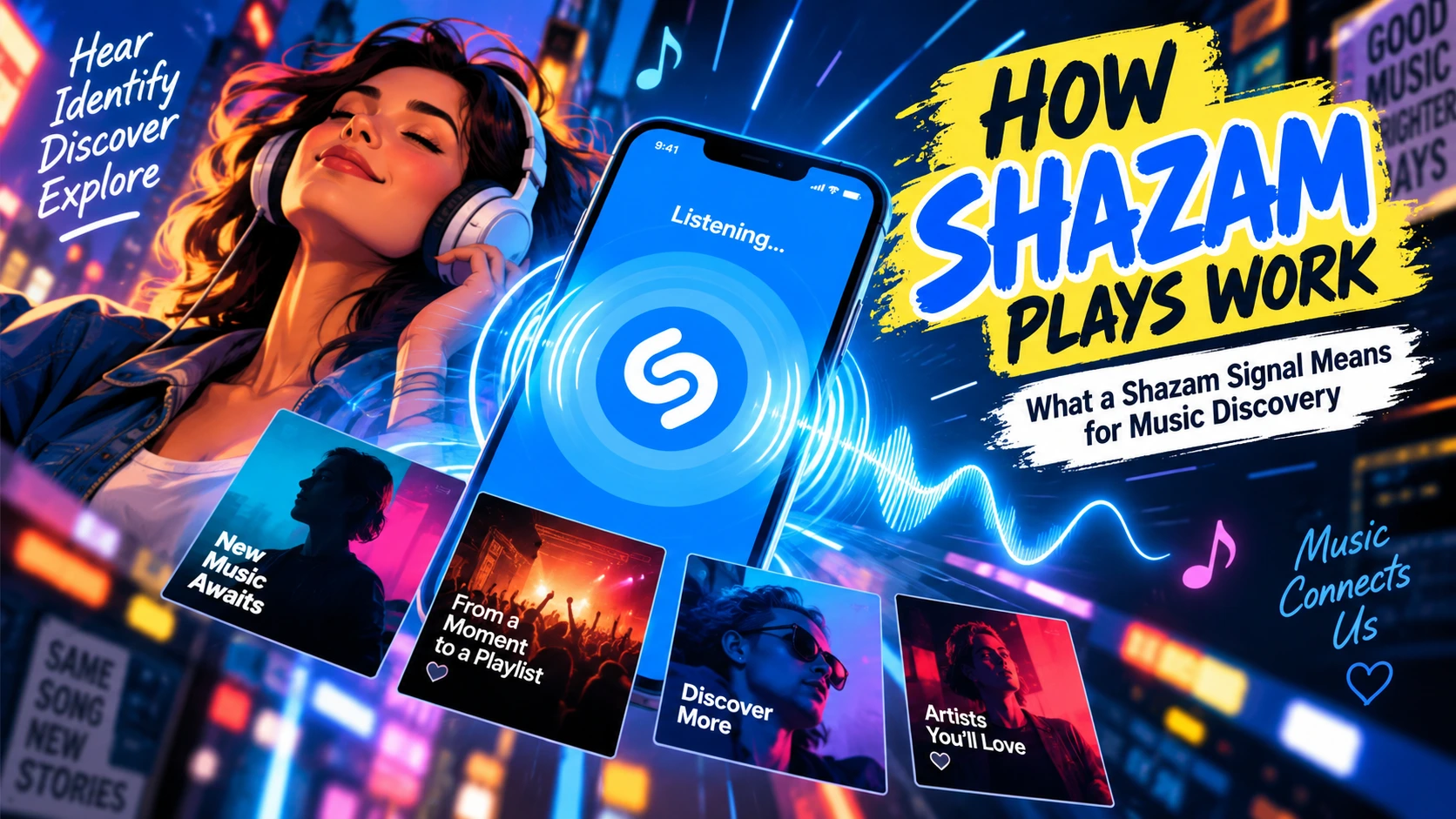
Spotify activity should also be kept separate from music-recognition metrics. A Shazam event means someone identified a song; it is not the same as a Spotify stream. See our guide to how Shazam plays work for that distinction.
Frequently Asked Questions
No. Streams count qualifying playback activity, while monthly listeners count unique people who streamed the artist during the latest rolling 28-day period. One listener can generate multiple streams, so stream totals and monthly-listener totals should not be expected to match.
Yes. One listener can generate multiple qualifying streams by playing music more than once. Spotify currently counts a song stream after at least 30 seconds of playback. That person still represents one unique listener during the relevant listener reporting period.
Because monthly listeners use a rolling 28-day window. Listeners from an earlier discovery spike can leave that window while a smaller group keeps streaming repeatedly. You can therefore have fewer unique listeners but more total streams at the same time.
No. Monthly listeners are unique people who streamed your music during the latest 28 days. Followers are people who chose to follow your Spotify artist profile. A follower may not listen during the current 28-day window, while a monthly listener does not need to follow you.
Streams per listener is the average number of streams generated per unique listener during the same reporting period. For example, 3,000 streams divided by 1,000 listeners equals 3 streams per listener. It is an average, not proof that every person played the track exactly three times.
Streams per listener is the average number of streams generated per unique listener during the same reporting period. For example, 3,000 streams divided by 1,000 listeners equals 3 streams per listener. It is an average, not proof that every person played the track exactly three times.
No. Existing listeners can generate additional streams without adding new unique listeners. Monthly listeners measure unique people within the rolling 28-day window, while streams measure qualifying playback activity. The two metrics can therefore increase at different rates or even move in opposite directions.
Sources
Spotify for Artists:
- How your streams are counted
- Understanding your listener and follower stats
- Source of streams
- Audience segments on Spotify
- Artificial streaming and paid third-party services that guarantee streams
Promobox:
About the author



Leave a Reply