

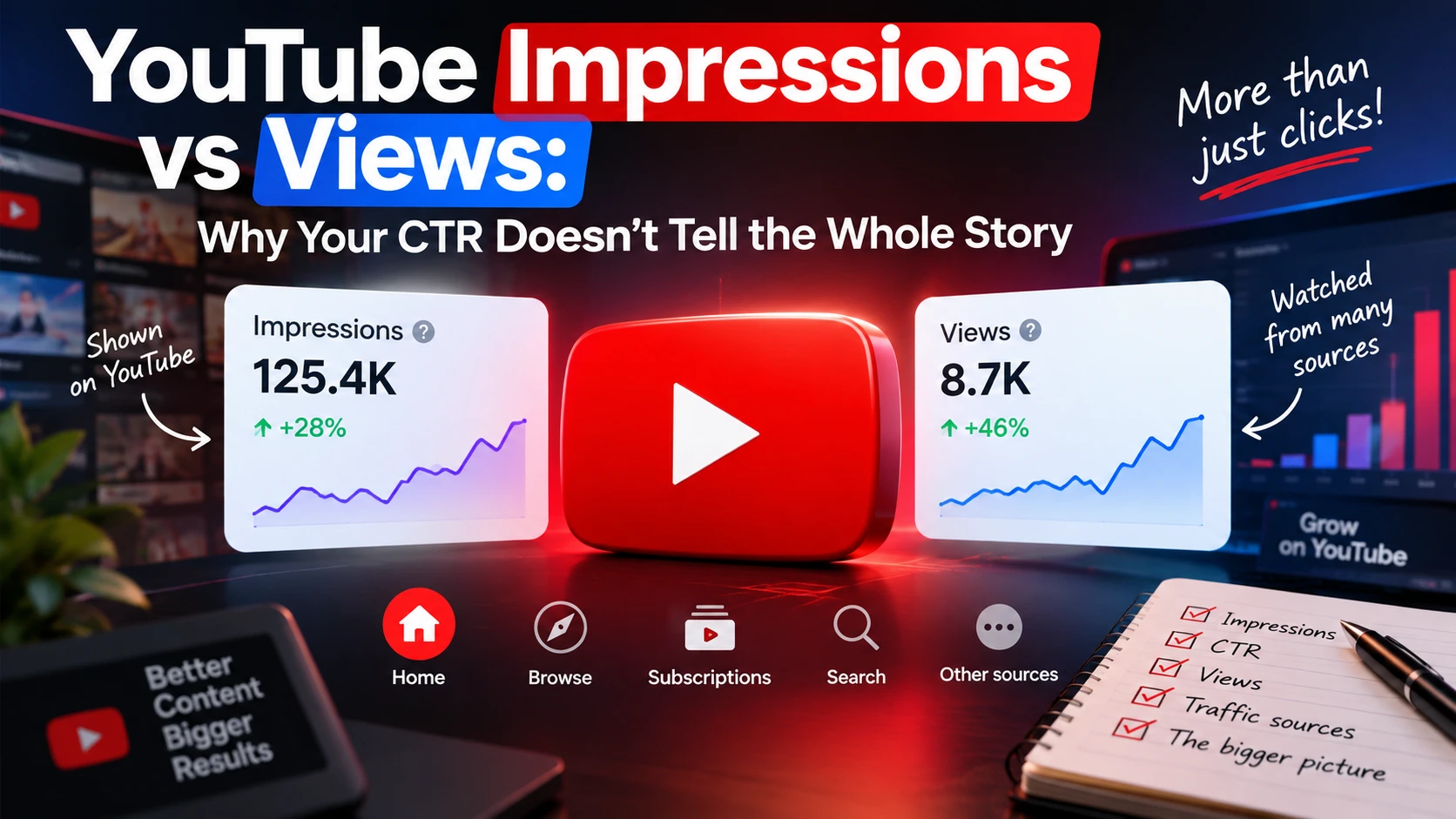
YouTube Impressions vs Views: The Short Answer
YouTube impressions count qualifying thumbnail displays on certain YouTube surfaces. Views count video viewing from multiple sources, including sources without a registered thumbnail impression. Impressions click-through rate measures only views resulting from counted impressions. That is why total views divided by impressions may not match your Studio CTR—and why views can rise while CTR falls. Compare the same video and reporting period before drawing conclusions.
This guide focuses on regular videos and thumbnail impressions, not advertising CTR or Shorts Feed metrics.
What Counts as a YouTube Impression?
YouTube requires a thumbnail to be visible for more than one second, with at least 50% of it on screen, for a qualifying impression. Placement matters too: not every thumbnail appearance counts.
The official thumbnail impressions documentation lists these examples:
| Counted on eligible surfaces, when visibility requirements are met | Not counted in thumbnail impressions |
|---|---|
| YouTube Search and the homepage | External websites and apps |
| Subscription and other listed YouTube feeds | Emails and notifications |
| Up Next recommendations | Cards and end screens inside the player |
| Playlists | YouTube’s mobile website, YouTube Kids and YouTube Music |
The table is a selection, not an exhaustive placement list.
An impression is therefore a defined analytics event—not every opportunity someone had to encounter your video. An email link can bring a viewer to the video without creating the same thumbnail-impression event as an eligible Search result.
Views vs Views from Impressions
Keep these three fields separate when reading a report:
| Metric | What it measures | Main limitation |
|---|---|---|
| Impressions | Registered thumbnail displays | Does not cover every encounter with the video |
| Views | Video views across traffic sources | Not every view follows a counted impression |
| Views from impressions | Views attributed to registered thumbnail impressions | Represents only the associated portion of total views |
An external website can send viewers without adding corresponding thumbnail impressions. However, total views minus views from impressions is not an external-traffic total. Other excluded placements can also generate viewing.
Use the traffic-source report to investigate the difference. YouTube’s Reach documentation distinguishes sources within YouTube from external websites and apps.
For the search-specific case, see YouTube search views. Search traffic is one route into a video; it should not be used as a label for all discovery or promotion.
How YouTube Impressions CTR Is Calculated
Use the views associated with counted impressions—not the entire view total:
Impressions CTR = views from counted impressions ÷ counted impressions × 100%
Consider this illustrative example for one video over one reporting period:
- Counted thumbnail impressions: 10,000
- Views from those impressions: 500
- Additional views from sources without counted impressions: 300
- Total views: 800
The impressions CTR is:
500 ÷ 10,000 × 100% = 5%
Dividing all 800 views by 10,000 impressions produces 8%, but that combines a broader numerator with a narrower denominator. It does not reproduce impressions CTR.
YouTube’s impressions and CTR FAQs explain that this metric covers a subset of viewing activity.
This is a teaching example, not a Promobox campaign result. In actual reports, allow for rounded figures and different update times. YouTube notes that key metric cards update more frequently than the impressions-to-watch-time report.
Why CTR Can Fall While Views Grow
A lower click-through percentage can accompany more viewing if the number of impressions increases sufficiently.
Here are two hypothetical, equal-length, non-overlapping periods for the same video:
| Period | Impressions | CTR | Views from impressions |
|---|---|---|---|
| A | 2,000 | 8% | 160 |
| B | 10,000 | 4% | 400 |
CTR halves, yet views from impressions increase from 160 to 400. The lower percentage does not, by itself, establish that the thumbnail became less effective.
Audience and placement changes can affect the comparison. Early exposure may include loyal viewers, while later impressions reach people less familiar with the channel. Search, Home and Suggested placements also put a video in different viewing contexts.
YouTube’s guide to interpreting CTR and impressions explains why audience expansion and traffic-source differences matter.
Do not reverse this into another shortcut: falling CTR does not automatically mean successful expansion. Check whether impressions actually increased, which sources changed and how many views resulted.
If impressions and views from impressions both fall, the example above does not explain your situation.
Why High CTR Doesn’t Guarantee More Impressions
A narrowly focused video can appeal strongly to a small audience without having a large potential audience beyond it. Early viewers may also be unusually familiar with the creator, making their response unrepresentative of later exposure.
Competition adds another constraint. A video can outperform your channel’s usual CTR while competing against other videos that appeal more strongly to a particular viewer. YouTube discusses these limitations in its CTR FAQs.
Do not treat one percentage as a universal threshold for recommendation growth. Compare videos with similar subjects, audiences, traffic sources and stages after publication.
A high CTR from a small sample is a reason to keep observing—not proof that YouTube should distribute the video more widely.
What to Check in YouTube Studio Before Making Changes
For an individual video on desktop, open YouTube Studio → Content → select the video → Analytics → Reach. This is the route described in YouTube’s Reach report instructions. Report availability can differ by device and content format.
Work through these checks:
- Fix the video and date range. Do not compare one video’s lifetime views with its impressions from the last week.
- Read the connected metrics. Compare impressions, impressions CTR and views from impressions in the relevant report. Keep total views alongside them as a separate figure.
- Inspect traffic sources. Determine whether the change involves Search, Browse, Suggested, External or another reported source. Do not expect every metric for every source.
- Match comparison windows. Use equal durations and note the video’s age. A launch period and a mature period can have different audience mixes.
- Check viewing after the click. Review average view duration and retention. The guide to watch time and audience retention explains their different roles.
- Record what changed. Note thumbnail edits, title changes, campaign dates and external placements. Timing identifies possibilities, not proven causes.
- Choose one action linked to a hypothesis. If the introduction fails to deliver the title’s promise, investigate that mismatch. If the change mainly reflects different traffic sources, avoid replacing the thumbnail solely because aggregate CTR declined.
Keep a record of the change and the comparison window. Otherwise, later improvements or declines become difficult to interpret.
How to Interpret Results After Video Promotion
More views after a campaign do not establish more organic impressions, improved impressions CTR or stronger search rankings.
Before promotion, record the video’s metrics and traffic-source mix. During and after it, compare equivalent periods, noting the video’s age and any simultaneous content changes. Look separately at total views, views from impressions and subsequent viewing behavior.
Promobox YouTube Views Prices
The following rates were checked in the YouTube views order form on September 22, 2026.
| Listed service | Price per view, USD | Calculated price for 1,000 views |
|---|---|---|
| Real User Views | $0.0013 | $1.30 |
| Premium Fast Views | $0.0018 | $1.80 |
| Native Ads Views | $0.0018 | $1.80 |
| Views for Restricted Content | $0.0020 | $2.00 |
| Views [PRO][1K] | $0.0015 | $1.50 |
| Views [PRO][3K] | $0.0018 | $1.80 |
| Views [PRO][5K] | $0.0020 | $2.00 |
The 1,000-view amounts are arithmetic conversions of the displayed unit rates, not separate fixed packages. Names are service labels, not independent verification of audience characteristics. Confirm the selected option’s quantity limits, content restrictions, conditions and checkout total before ordering; prices can change.
Do not assume every option delivers the same traffic source or produces counted thumbnail impressions. An order quantity is not a forecast of Studio’s impressions, CTR or organic results.
YouTube’s fake engagement policy prohibits artificial inflation of metrics and warns that a hired promoter’s methods can affect the channel. A commercial listing does not establish platform approval or compliance.
FAQ
Some viewing does not begin with a registered thumbnail impression. External links, notifications and other excluded placements can contribute views. Compare the same video and date range, then inspect traffic sources rather than assuming the difference indicates a reporting error.
Impressions CTR uses views attributed to counted thumbnail impressions, not every view the video received. Using total views changes the numerator. Even with the correct fields, displayed rounding and different report update times can prevent an exact manual match.
A view reached directly through an external link is not added to the numerator simply because the video was watched. Impressions CTR concerns viewing associated with registered YouTube thumbnail impressions. Inspect external traffic separately when evaluating a campaign’s results.
No. A larger impression base can generate more views even with a lower click-through percentage. But the decline is not automatically positive either. Check impressions, resulting views, traffic sources and viewing behavior before deciding whether the video needs changes.
The video may appeal to a small, loyal audience, address a limited-interest topic or face strong competition. A high percentage alone does not establish broad demand. Compare similar videos and audience contexts before expecting a larger volume of impressions.
About the author




Leave a Reply