

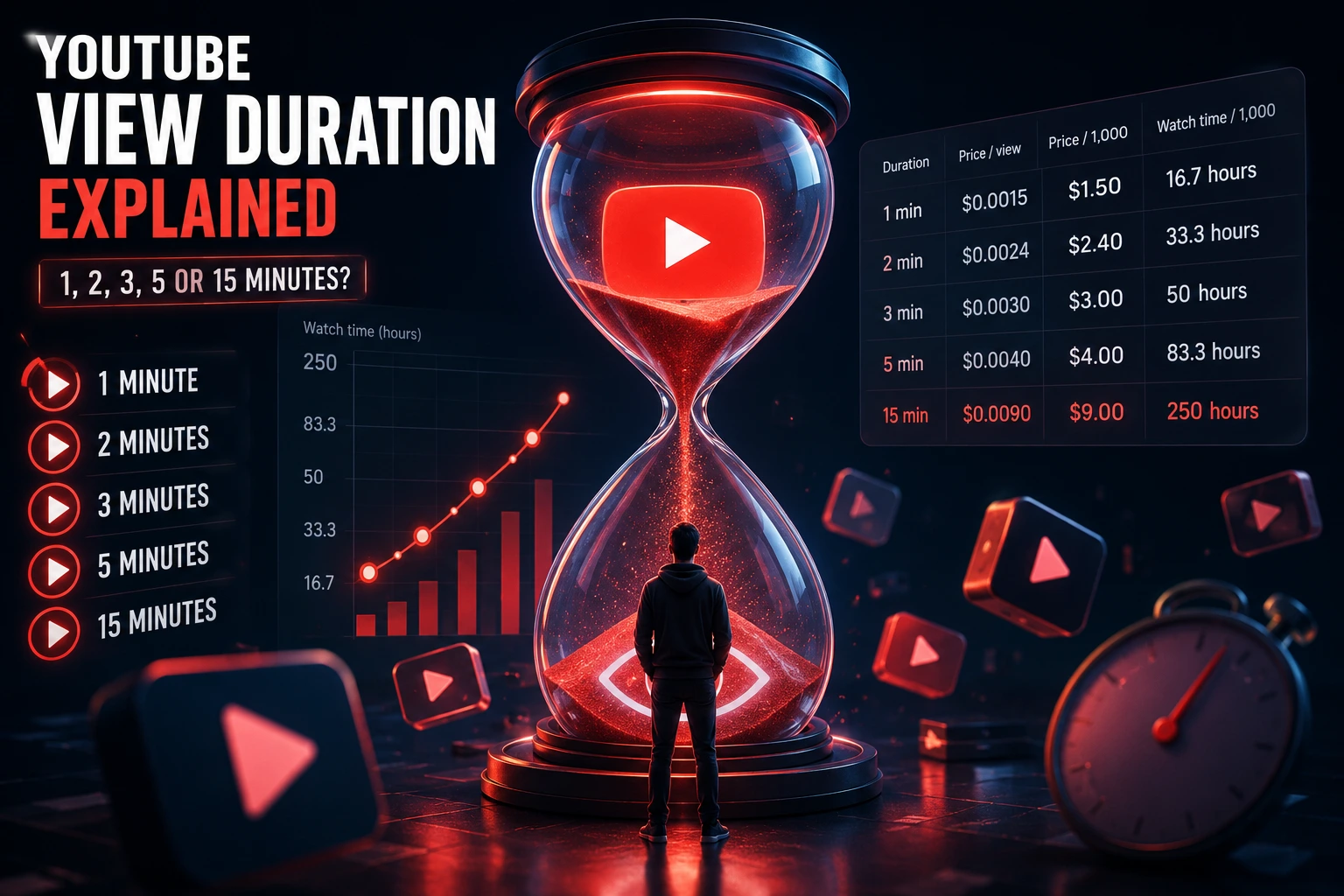
When buying high-retention YouTube views, one of the main differences between services is view duration: how long each delivered view is intended to remain on the video.
Promobox currently offers YouTube high-retention view packages with durations of 1, 2, 3, 5 and 15 minutes. The longer the selected duration, the more viewing time can theoretically be generated from the same number of views.
However, view duration should not be confused with guaranteed YouTube watch hours, monetization eligibility or organic audience retention. YouTube measures watch time and average view duration through its own analytics systems, and only qualifying watch time counts toward YouTube Partner Program requirements.
Quick Answer
A YouTube view-duration service specifies approximately how long each ordered view is intended to watch the selected video.
For example:
- a 1-minute view is designed to remain on the video for around one minute;
- a 5-minute view is designed for around five minutes;
- a 15-minute view is designed for substantially longer viewing sessions.
Promobox currently provides five duration options:
| View duration | Price per view | Price per 1,000 views | Theoretical viewing time from 1,000 views |
|---|---|---|---|
| 1 minute | $0.0015 | $1.50 | 16.7 hours |
| 2 minutes | $0.0024 | $2.40 | 33.3 hours |
| 3 minutes | $0.0030 | $3.00 | 50 hours |
| 5 minutes | $0.0040 | $4.00 | 83.3 hours |
| 15 minutes | $0.0090 | $9.00 | 250 hours |
The viewing-time column is a mathematical calculation based on the selected duration, not a guarantee that YouTube will record the same amount as valid public watch time.
What Does “View Duration” Mean?
In this type of YouTube promotion service, view duration refers to the intended amount of time associated with each delivered view.
The calculation is straightforward:
Number of views × duration per view = theoretical total viewing time
For example:
1,000 views × 5 minutes = 5,000 minutes
5,000 minutes equals approximately:
83.3 hours
This makes a 5-minute package fundamentally different from a package that simply delivers views without specifying how long those sessions should last.
From the perspective of YouTube Analytics, the closest related metrics are watch time and average view duration. YouTube defines average view duration as the average number of minutes watched per view for the selected content and reporting period.
1-Minute YouTube Views
Promobox currently lists its 1-minute package at:
$0.0015 per view
That means:
| Quantity | Price | Theoretical viewing time |
|---|---|---|
| 1,000 views | $1.50 | 16.7 hours |
| 5,000 views | $7.50 | 83.3 hours |
| 10,000 views | $15.00 | 166.7 hours |
| 50,000 views | $75.00 | 833.3 hours |
When does 1-minute duration make sense?
A 1-minute package can be suitable when the primary objective is increasing the visible view count while adding a defined amount of viewing duration.
It can also be more appropriate for relatively short videos where ordering a 15-minute duration would make little practical sense.
For example, a two-minute video obviously cannot produce a continuous 15-minute first-pass viewing session without some form of repeated playback.
That is why the selected duration should generally correspond reasonably to the actual length of the promoted video.
2-Minute YouTube Views
The current Promobox price for the 2-minute option is:
$0.0024 per view
At 1,000 views:
1,000 × 2 minutes = 2,000 minutes = 33.3 hours
Example costs:
| Quantity | Price | Theoretical viewing time |
|---|---|---|
| 1,000 | $2.40 | 33.3 hours |
| 5,000 | $12.00 | 166.7 hours |
| 10,000 | $24.00 | 333.3 hours |
| 50,000 | $120.00 | 1,666.7 hours |
A two-minute duration can be a middle-ground option for videos that are several minutes long but do not require extended viewing sessions.
3-Minute YouTube Views
The 3-minute package currently costs:
$0.003 per view
This is particularly easy to calculate:
1,000 views × 3 minutes = 3,000 minutes = 50 hours
Therefore:
| Quantity | Price | Theoretical viewing time |
|---|---|---|
| 1,000 | $3.00 | 50 hours |
| 5,000 | $15.00 | 250 hours |
| 10,000 | $30.00 | 500 hours |
| 20,000 | $60.00 | 1,000 hours |
Again, the last column represents arithmetic based on the ordered duration. It should not be interpreted as guaranteed YouTube Analytics or YPP watch time.
5-Minute YouTube Views
Promobox lists the 5-minute option at:
$0.004 per view
This package provides substantially more theoretical viewing time per thousand views:
1,000 × 5 minutes = 5,000 minutes = 83.3 hours
Examples:
| Quantity | Price | Theoretical viewing time |
|---|---|---|
| 1,000 | $4.00 | 83.3 hours |
| 5,000 | $20.00 | 416.7 hours |
| 10,000 | $40.00 | 833.3 hours |
| 12,000 | $48.00 | 1,000 hours |
For longer videos, podcasts, tutorials, interviews and other long-form content, a five-minute duration may be more relevant than one- or two-minute viewing sessions.
15-Minute YouTube Views
The longest option currently displayed by Promobox is:
15 minutes at $0.009 per view
At this duration:
1,000 views × 15 minutes = 15,000 minutes
or:
250 theoretical viewing hours
Examples:
| Quantity | Price | Theoretical viewing time |
|---|---|---|
| 1,000 | $9.00 | 250 hours |
| 2,000 | $18.00 | 500 hours |
| 4,000 | $36.00 | 1,000 hours |
| 10,000 | $90.00 | 2,500 hours |
This option is primarily relevant to longer videos where a 15-minute viewing duration is plausible.
For a three-minute video, selecting a 15-minute duration would not have the same straightforward interpretation as it would for a 30-minute video.
Which YouTube View Duration Should You Choose?
There is no universally correct duration.
A useful starting point is to compare the package with the actual length of the video.
| Video length | Possible duration to consider |
|---|---|
| Under 2 minutes | 1 minute |
| 2–4 minutes | 1–2 minutes |
| 4–8 minutes | 2–5 minutes |
| 8–20 minutes | 3–15 minutes |
| 20+ minutes | 5–15 minutes |
These are not YouTube recommendations. They are practical examples showing how an ordered viewing duration can be aligned with video length.
For example, if a video is 12 minutes long, a five-minute option represents approximately 42% of its total runtime.
If the same video receives a one-minute session, the corresponding proportion is only about 8%.
This distinction becomes important when comparing view packages that deliver the same visible number of views but very different viewing durations.
View Duration vs Audience Retention
These terms should not be treated as synonyms.
View duration in the context of a promotion service describes how long an individual ordered viewing session is intended to last.
Audience retention is a YouTube Analytics measurement showing how well different parts of a video retain viewers.
YouTube provides a dedicated audience-retention report at the individual video level. The retention graph can show where viewers continue watching, rewatch sections or leave the video.
So, for example:
A purchased package may specify a 5-minute view duration.
But that does not mean YouTube will report:
5:00 average view duration
for the video as a whole.
The final metric depends on all qualifying views and viewing behavior associated with the video.
View Duration vs Watch Time
Watch time measures the total amount of time viewers have spent watching content.
Conceptually:
1 view × 5 minutes = 5 minutes of viewing
while:
1,000 views × 5 minutes = 5,000 minutes
However, YouTube determines the watch-time metrics ultimately displayed in YouTube Studio.
The Engagement section of YouTube Analytics includes both total watch time and average view duration.
This distinction matters because an external service can describe what it is designed to deliver, but it cannot independently determine what YouTube ultimately considers valid engagement.
Does Longer View Duration Automatically Improve a Video’s Ranking?
No guaranteed relationship can be stated.
YouTube does use viewer behavior and satisfaction signals in its recommendation systems, and its own guidance encourages creators to examine audience-retention curves to understand where viewers remain interested or leave.
But it would be incorrect to reduce YouTube ranking to a formula such as:
longer view duration = higher ranking
YouTube recommendations depend on many signals.
Therefore, Promobox high-retention views should not be described as guaranteeing:
- higher search rankings;
- Suggested Video placement;
- homepage recommendations;
- viral distribution;
- monetization;
- subscribers;
- comments;
- sales.
The service changes the characteristics of the ordered viewing activity; it does not guarantee downstream YouTube outcomes.
Are High-Retention Views the Same as Organic Views?
No.
Organic viewers discover and choose to watch a video through sources such as search, recommendations, subscriptions, external websites or direct links.
A purchased high-retention view is ordered through a promotion service.
The two therefore represent different acquisition mechanisms even if both ultimately involve a video being viewed.
This distinction is important when evaluating channel performance. Creators should continue using YouTube Analytics to examine organic audience behavior rather than treating purchased traffic as a substitute for genuine audience development.
Can High-Retention Views Be Used to Reach YouTube Monetization Requirements?
They should not be purchased on the assumption that they will qualify a channel for monetization.
YouTube currently distinguishes valid public watch hours from general watch-time statistics when evaluating YouTube Partner Program eligibility.
For the standard long-form route, YouTube states that channels can qualify with 1,000 subscribers and 4,000 valid public watch hours during the previous 12 months, subject to the rest of the YPP requirements.
Not every type of watch time qualifies.
For example, YouTube specifically says that watch hours generated by Shorts viewed in the Shorts Feed do not count toward the 4,000-hour threshold.
Therefore, calculations in this article such as:
4,000 × 15 minutes = 1,000 hours
are mathematical comparisons only.
They are not a claim that buying 4,000 15-minute views will generate 1,000 valid public watch hours for YPP purposes.
How Much Does Each Hour of Theoretical Viewing Time Cost?
The pricing creates an interesting comparison.
Based on current Promobox prices:
| Package | Cost per 1,000 | Theoretical hours | Approx. cost per theoretical viewing hour |
|---|---|---|---|
| 1 minute | $1.50 | 16.7 h | $0.090 |
| 2 minutes | $2.40 | 33.3 h | $0.072 |
| 3 minutes | $3.00 | 50 h | $0.060 |
| 5 minutes | $4.00 | 83.3 h | $0.048 |
| 15 minutes | $9.00 | 250 h | $0.036 |
This reveals something that is not immediately obvious from the per-view pricing:
longer-duration packages currently cost more per view but less per theoretical minute of viewing time.
For example:
- 1,000 one-minute views cost $1.50;
- 1,000 fifteen-minute views cost six times as much at $9;
- but they theoretically represent fifteen times as much viewing duration.
That makes the 15-minute package approximately 2.5 times cheaper per theoretical viewing hour than the 1-minute option.
This does not mean it is automatically the best package. The actual video length and purpose of the order still matter.
Example: A 10-Minute YouTube Video
Consider a 10-minute tutorial receiving 1,000 views.
With a 1-minute duration:
1,000 × 1 minute = 1,000 minutes
The theoretical viewing duration represents about 10% of the video’s runtime per view.
With a 5-minute duration:
1,000 × 5 minutes = 5,000 minutes
That represents approximately 50% of the runtime per view.
With a 15-minute package, however, the selected duration exceeds the actual length of the video.
This demonstrates why choosing the largest available number is not necessarily the most logical approach.
Example: A 30-Minute YouTube Video
For a 30-minute interview, webinar or podcast, the comparison looks different.
A 1-minute session represents only:
3.3% of the video
A 5-minute session represents:
16.7%
A 15-minute session represents:
50%
For long-form content, longer-duration packages therefore have a clearer practical interpretation.
How Promobox High-Retention YouTube Views Work
The ordering process is straightforward.
The customer:
- selects the required YouTube view-duration service;
- specifies the number of views;
- provides the requested YouTube video URL;
- reviews the calculated order total;
- submits the order.
The available high-retention options currently shown by Promobox are:
- 1-minute duration — $0.0015/view;
- 2-minute duration — $0.0024/view;
- 3-minute duration — $0.003/view;
- 5-minute duration — $0.004/view;
- 15-minute duration — $0.009/view.
The service interface currently describes these packages as non-drop.
Prices and service parameters can change, so the order page should be treated as the current source for live pricing.
What High-Retention Views Cannot Guarantee
Buying YouTube views with a specified duration does not guarantee:
- organic viewers;
- new subscribers;
- likes or comments;
- conversions or sales;
- YouTube Search rankings;
- recommendations;
- placement on the homepage;
- viral growth;
- YouTube verification;
- YPP acceptance;
- monetization;
- a particular average view duration in YouTube Analytics.
Those outcomes depend on YouTube’s systems and actual viewer behavior.
High-retention views are therefore better understood as a specific traffic service with a defined viewing-duration parameter, rather than as a guaranteed method for achieving broader channel outcomes.
Frequently Asked Questions
A high-retention YouTube view is a view delivered with a specified intended viewing duration rather than only a view-count target. Promobox currently offers durations from 1 to 15 minutes.
Not necessarily. A 15-minute duration provides more theoretical viewing time, but it is mainly relevant to sufficiently long videos. A shorter duration may make more sense for short content.
At the currently displayed Promobox rate of $0.0015 per view, 1,000 one-minute views cost $1.50.
At $0.004 per view, 1,000 five-minute views cost $4.00.
At $0.009 per view, 1,000 fifteen-minute views cost $9.00.
Mathematically:
1,000 × 5 minutes = 5,000 minutes.
5,000 ÷ 60 = approximately 83.3 hours.
This is theoretical viewing duration and not a guarantee of recorded or monetization-eligible YouTube watch hours.
1,000 × 15 minutes = 15,000 minutes, or 250 hours of theoretical viewing duration.
It cannot be guaranteed. YouTube calculates average view duration using the viewing activity it recognizes for the video. YouTube defines the metric as the average number of minutes watched per view.
No. YouTube uses valid public watch hours for YPP eligibility, and purchased viewing duration should not be treated as guaranteed qualifying watch time.
Choose a duration that makes sense relative to the actual length of the video and the objective of the order. There is little practical reason to select a viewing duration far longer than the video itself.
Bottom Line
The difference between 1-, 2-, 3-, 5- and 15-minute YouTube views is not simply the number of views delivered. It is the amount of viewing duration attached to each package.
At Promobox’s current displayed rates, 1,000 views represent:
- 1 minute: 16.7 theoretical hours for $1.50;
- 2 minutes: 33.3 hours for $2.40;
- 3 minutes: 50 hours for $3.00;
- 5 minutes: 83.3 hours for $4.00;
- 15 minutes: 250 hours for $9.00.
Longer-duration options therefore provide a lower cost per theoretical minute of viewing time.
But those figures should be interpreted correctly: they describe the parameters and mathematical output of the ordered service, not guaranteed YouTube Analytics metrics, ranking improvements or valid public watch hours.
YouTube itself measures watch time, average view duration and audience retention, and its retention reports show how effectively individual portions of a video hold viewer attention.
For creators, the sensible approach is to treat high-retention views as one promotional tool while continuing to improve the factors that generate genuine viewer retention: the topic, thumbnail, title, opening, pacing and overall value of the video.
About the author




Leave a Reply